
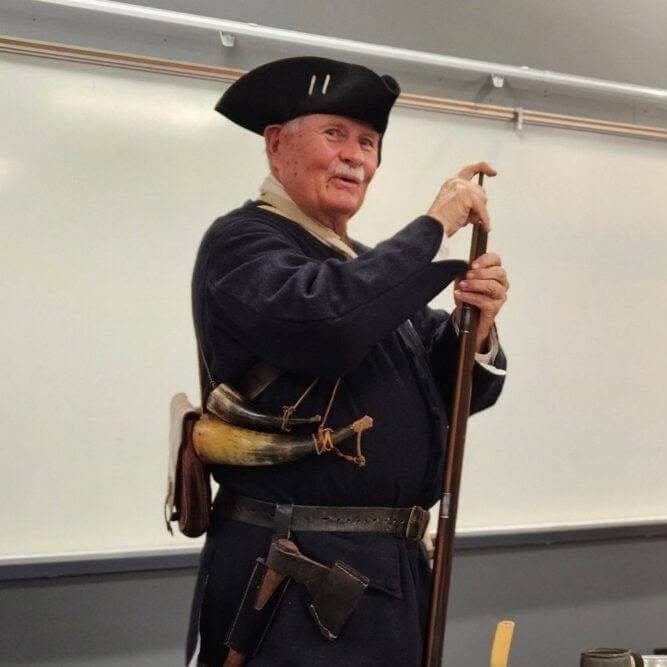
Dwyer, a military historian with an extensive collection of soldier gear and equipment from the Revolutionary War period, will bring items carried and used by the New Jersey militia. Attendees will be able to see the pieces, pass them around and touch them.
A New Jersey native with 37 years of service in the U.S. Army, Army Reserve and Army National Guard, Dwyer got his start in this kind of history as a college student, giving programs to visitors at Washington’s Headquarters and Jockey Hollow for the National Park Service. He has stressed that “it was a militia unit that started the American Revolution.”
The story begins in the spring of 1775. On May 3, New Jersey became one of the first colonies to organize a militia after the first shots of the Revolution were fired at Lexington that April. For the next eight years, its citizen soldiers fought the British, Hessians, Tories and Native American forces in defense of liberty. They raided supply columns, spied on enemy camps, arrested Tories and British sympathizers, and sometimes fought alongside the Continental Army.
Service was a demanding commitment. Dwyer has described how the Provincial Congress called for companies of 60 men who drilled twice a week. When enlistment fell short, it turned to conscription of men aged 16 to 50, who served one-month terms and were expected to supply their own musket. A man without a firearm faced a fine of two shillings, roughly a week’s pay for many tradesmen.
Many militiamen were hunters and skilled marksmen. When they served with the Continental Army, they were often placed on the flanks as sharpshooters to target British officers, sergeants and drummers, disrupting enemy command and communication. Captured militiamen risked harsher treatment than regular soldiers, because the British did not regard them as professionals and sometimes hanged them as assassins.
The program will cover training, pay, Tories in New Jersey, the raid on Flemington, stopping the London Trade and American privateers.
The London Trade was illegal commerce with the British forces based in and around New York. Middlemen moved goods between the Jersey shore, Staten Island and Sandy Hook and into British lines. In Monmouth County, the militia was the main check on the trade. The New Jersey Supreme Court tried 245 cases against Monmouth County residents between 1776 and 1784, and 126 of them involved crossing enemy lines or supplying the enemy, according to the Monmouth County Historical Association.
Privateering offered another front. Militia officers along the Monmouth shore commanded armed vessels, and crews shared the proceeds from captured ships. In October 1778, the poet Philip Freneau sailed from Shrewsbury Inlet aboard the Indian Delaware, a schooner awarded to militia officer Daniel Hendrickson.
Hunterdon County history records a December 14, 1776, clash in Flemington, when Cornet Francis Geary and his light dragoons, on a foraging mission, were ambushed by seven local men.
Time will be set aside for audience questions at the end of the program.